Article
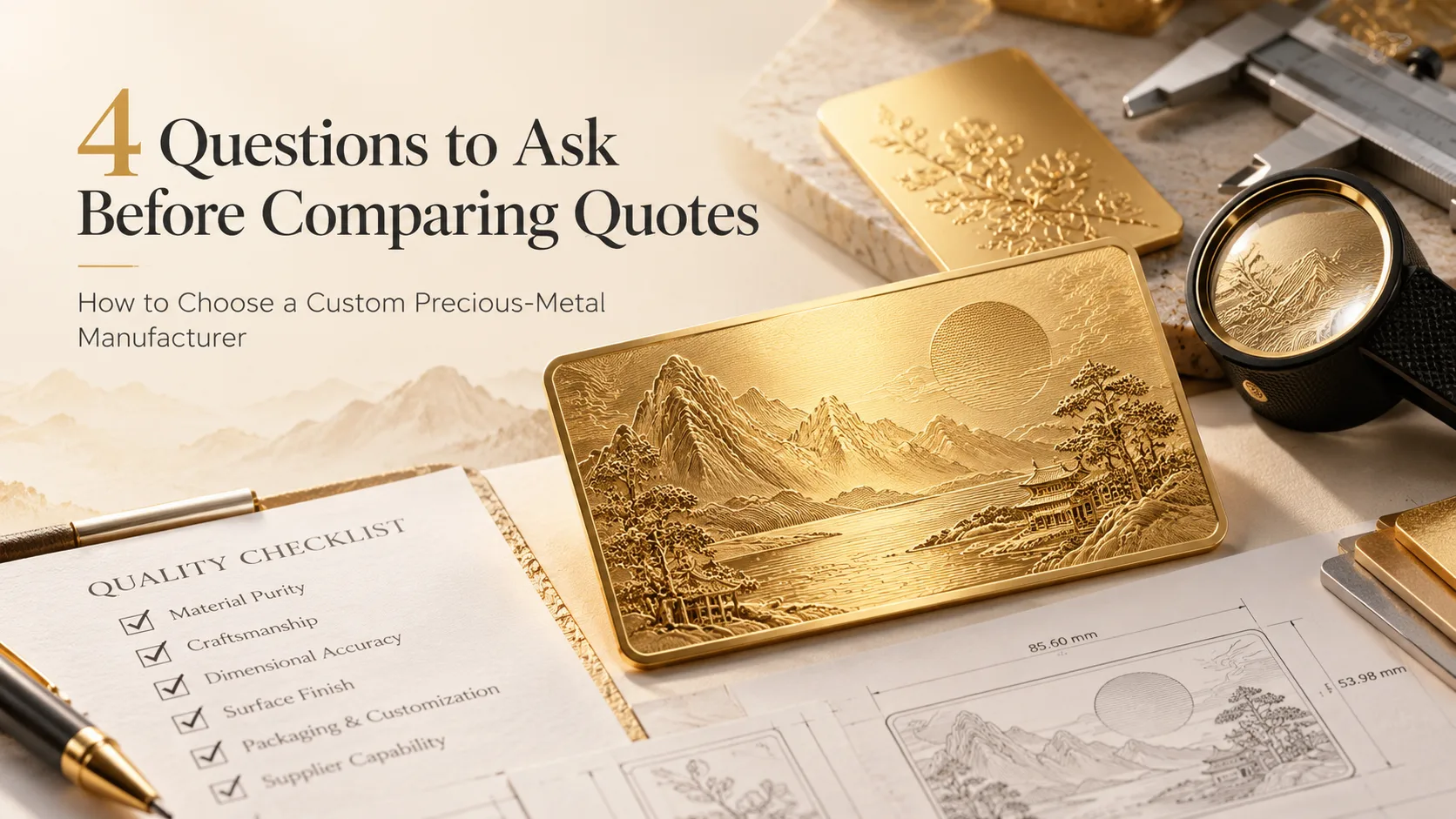
To choose a custom precious metal manufacturer for goldnotes, gold cards, or commemorative gifts, confirm four things before comparing prices: agreed quality standards, responsibility for defects, tooling and sampling costs, and verified metal purity and content. Compare quotations only when the product specifications and commercial terms are equivalent.
For corporate buyers, jewelry retailers, gifting companies, and collectible brands, unit price matters. But two similar-looking products can differ substantially in materials, workmanship, inspection requirements, and the cost of resolving production problems.
This guide focuses on custom gold and silver gifts and collectibles, including goldnotes, gold cards, and gold foil artwork. The following questions will help you assess a supplier’s quotation before committing to development or production.
1. Will Quality Standards Stay Consistent Across Different Order Quantities?
A smaller order does not have to mean lower quality. Ask the manufacturer to confirm the same agreed product specifications and acceptance criteria across order quantities, while explaining any differences in setup charges, production arrangements, or inspection plans.
Why Smaller Orders Can Cost More per Piece
In precious metal OEM manufacturing, costs extend beyond raw materials and labor. Depending on the product, they may include:
- Tooling and mold preparation
- Equipment setup and calibration
- Process trials and adjustments
- Material waste and production losses
- Finishing and quality inspection
Some of these costs are incurred before regular production begins. In a hypothetical goldnote project, preparing the tooling and adjusting the pressing process may be necessary for both a 300-piece order and a 3,000-piece order. With fewer pieces, each unit absorbs a larger share of those costs.
Manufacturers may manage small-order costs through setup fees, production scheduling, tooling reuse, or process efficiencies. If a lower quotation depends on changes to materials, finishing, or inspection scope, those changes should be disclosed and approved before production.
The Same Process Name Does Not Define the Finished Result
Descriptions such as “gold foil embossing” or “precision pressing” do not tell buyers exactly what the finished product will look like. In goldnote manufacturing, relevant requirements can include:
- Fine-line clarity and legibility of small text
- Embossing depth and detail reproduction
- Alignment between printed and embossed elements, where applicable
- Surface finish and visible marks
- Consistency across the production batch
Ask the supplier to document these requirements using approved reference samples, measurable specifications, and suitable inspection methods. For visual checks, agree on viewing conditions so that both parties assess the product consistently.
The same product acceptance criteria do not necessarily require the same number of inspected pieces at every order quantity. Define the product requirements and the inspection plan separately, including whether particular checks apply to every piece or to a sample from the batch.
Ask the supplier: “Will an order of 300 pieces meet the same agreed product specifications as an order of 3,000 pieces, and how will you verify this?”
2. What Happens If a Production Batch Contains Defective Products?
Agree on defect definitions, inspection procedures, and corrective-action responsibilities before mass production. The written terms should explain when rework or replacement is required, who pays the associated costs, and how quickly the supplier must respond.
Define What Counts as an Unacceptable Defect
Imagine a shipment of commemorative gold cards with artwork that is visibly misaligned. The manufacturer may consider the deviation minor, while the buyer considers the affected pieces unsuitable for a premium retail collection. This hypothetical dispute is harder to resolve if alignment tolerances were never agreed.
Similar disagreements can arise over:
- Color differences: How closely must the production batch match the approved sample, and under what viewing conditions?
- Embossing depth: Which details must remain clear and consistently reproduced?
- Surface imperfections: Which scratches, marks, or finish variations are unacceptable on visible surfaces?
For precious metal quality control, broad descriptions such as “premium finish” are less useful than specific acceptance criteria. A reference sample should be supported by written requirements where appearance alone leaves room for interpretation.
Establish Whether Rework Is Practical
Some defects may be corrected, while others may require a replacement piece. An embossing error, for example, may not be correctable by pressing the same foil again. If the foil has already been bonded to a substrate, rework may also damage other parts of the product.
The remedy therefore needs to account for the product’s construction, intended use, and delivery deadline. A discount may be acceptable in some cases, but it does not solve the problem when the buyer cannot use or sell the affected goods.
Before approving production, clarify:
- Which defects require rejection, and which variations are within tolerance?
- How will affected quantities be inspected and documented?
- When is rework acceptable, and when is replacement required?
- Who pays for corrective work, replacement materials, and additional shipping when manufacturing caused the defect?
- What are the reporting, response, and replacement timelines?
Ask the supplier: “If the delivered products fail to meet our approved specifications, what corrective action will you take, at whose cost, and within what timeframe?”
3. How Are Design, Tooling, Sampling, and Revision Costs Calculated?
Request an itemized development quotation before paying for tooling or samples. It should state what each fee covers, how many revisions are included, who owns the tooling, and whether any fees can be credited toward a production order.
A typical custom project moves through four stages:
Design and feasibility review → Tooling and process development → Sampling and approval → Mass production
Each stage can involve technical adjustments and approval decisions. Understanding OEM sampling and tooling costs means checking the total development scope, including what happens if the first sample needs changes.
Why Artwork May Need Manufacturing Adjustments
Artwork that looks clear on screen may need modification for production. For example, a goldnote design with very fine lettering and detailed borders may need adjustments to suit:
- Metal foil thickness and forming behavior
- Tooling precision
- Required embossing depth
- Protective films or supporting substrates
- Alignment between different production stages
Ask whether manufacturing adaptations are included in the design or engineering fee. Agree on changes before tooling begins, especially when they affect the appearance or dimensions of the finished product.
Separate Design Changes from Manufacturing Nonconformity
Consider a hypothetical high-relief collectible. After reviewing a sample, the customer requests a substantially higher relief or a new composition. Depending on the change, the manufacturer may need to modify or replace the tooling.
That is different from a sample failing to meet an already approved specification:
- Customer-requested changes: The agreed requirements have changed. Additional development fees and a revised schedule may be appropriate.
- Manufacturer-caused nonconformity: The sample does not meet the agreed requirements. Responsibility for correction should follow the written development terms.
Request a breakdown of design and engineering fees, tooling costs, physical samples, included revisions, and additional revision charges. Also clarify tooling ownership, storage and future reuse, and any conditions for crediting development fees toward production.
Ask the supplier: “What does the development quotation include, and how are charges handled for a design change versus a sample that fails to meet the agreed specification?”
4. How Are Precious-Metal Purity, Weight, and Material Prices Verified?
Confirm which component contains gold or silver, its declared purity, and what the quoted weight represents. Agree separately on purity verification, weight verification, and the date or event that fixes the material price.
Distinguish Purity, Component Weight, and Fine-Metal Content
For custom gold foil gifts and silver collectibles, a finished piece may include precious metal, protective film, adhesive, a supporting substrate, and a frame. These terms describe different things:
| Specification | What it describes |
|---|---|
| Finished product weight | The combined weight of all components included in the stated measurement |
| Metal-component weight | The weight of a specified metal part, including any alloying elements or impurities |
| Purity or fineness | The proportion of gold or silver in that metal material |
| Fine-metal content | The weight of gold or silver itself, excluding other materials |
Fineness is expressed in parts per thousand by mass, as explained in LBMA’s guide to gold purity. A fineness of 999 corresponds to 99.9% purity in the specified metal material. It does not mean that a finished composite product is 99.9% precious metal.
Also ask whether a quoted weight is a design target, a batch average, or a guaranteed minimum per piece. Any applicable tolerances should be stated explicitly.
Material descriptions should distinguish precious-metal foil, precious-metal plating, and metal-look decorative films. These constructions should not be treated as equivalent when comparing quotations.
Agree on Verification Methods for the Actual Construction
Weighing a finished composite product does not establish its gold or silver content. Similarly, a purity result for one metal component does not establish how much of that component is present in the finished piece.
The verification plan should identify:
- The material or component being checked
- The claim being verified: purity, component weight, or fine-metal content
- The weighing or testing method and its suitability for the product
- How documents and test results relate to the supplied batch
- Whether testing requires a separate sample or destructive preparation
Depending on the project, supporting evidence may include material documentation, calibrated component weighing, and appropriate independent laboratory testing. For bonded or layered products, agree with the testing provider on what the selected method can establish.
Define How the Material Price Is Fixed
For products containing significant quantities of gold or silver, material-price movements can affect the order value. Before placing an order, clarify:
- Which market reference and pricing unit are used?
- On which date or payment event is the price fixed?
- How are currency conversion and exchange-rate changes handled?
- Does the quotation include material premiums and production losses?
- Under what circumstances can the material charge change?
Ask the supplier: “What precious-metal content is specified per piece, how will it be verified, and when is the material price fixed?”
Supplier Checklist: What to Request Before Comparing Quotations
Use this checklist to collect comparable information from each supplier:
| Area | Documents or details to request |
|---|---|
| Quality standards | Approved reference sample, measurable tolerances, visual acceptance criteria, and an inspection plan |
| Defect responsibility | Written rework or replacement terms, cost allocation, and reporting and corrective-action timelines |
| Development costs | Itemized quotation, included revisions, tooling ownership and reuse terms, and any fee-credit conditions |
| Precious-metal content and pricing | Component specifications, declared purity, weight basis and tolerances, verification methods, and price-fixing terms |
A meaningful comparison includes development, production, packaging, inspection, and delivery costs, as well as responsibility for correcting defects. Confirm the sampling schedule, production lead time, and shipping arrangements alongside the four areas above.
Before comparing prices, make sure you are comparing the same materials, manufacturing requirements, quality standards, and commercial terms.
For a goldnote-specific sourcing example, read why goldnote supplier quality and delivery matter beyond price.
Frequently Asked Questions
Does a smaller order mean lower manufacturing quality?
No. A smaller order can meet the same agreed product specifications as a larger order. Unit costs may be higher because setup and tooling costs are spread across fewer pieces. Ask the manufacturer to explain the pricing and inspection plan without changing the agreed acceptance criteria.
What quality-control standards should I request from a precious-metal manufacturer?
Request an approved reference sample, material specifications, dimensional and visual tolerances, inspection methods, and defect definitions. Also agree on how nonconforming products will be documented and handled. The requirements should reflect the product’s construction and intended use.
Are tooling and sampling fees always included in OEM manufacturing quotations?
No. Design, engineering, tooling, sampling, and revision fees may be separate. Request an itemized quotation and clarify included revisions, tooling ownership, future reuse, and any conditions for crediting development fees toward a production order.
How can I verify gold or silver content in a custom collectible?
First define the relevant component, declared purity, and required fine-metal content. Then agree on suitable documentation, weighing, and testing methods. Total finished weight alone cannot verify precious-metal content when the product also contains film, adhesive, framing, or other materials.
What should I prepare before requesting a custom manufacturing quotation?
Prepare your artwork or reference images, product dimensions, target quantity, material requirements, packaging preferences, and delivery destination and deadline. Include any required purity, metal weight, finish, or inspection criteria. If a specification is undecided, identify it as a point for feasibility review.
Discuss Your Custom Precious-Metal Project
Eshin-Gift Company is a Shenzhen-based manufacturer established in 1999, specializing in custom precious-metal gifts, goldnotes, gold foil artwork, and commemorative collectibles.
Planning a custom goldnote, gold card, or precious-metal gift? Send your artwork, target quantity, dimensions, material requirements, and delivery deadline to discuss feasibility, sampling, and quotation details.
Request a quotation for your custom precious-metal project, or email ashley@eshin-gift.com.
Planning a related custom project? Browse product formats, review craft capabilities, or request a quotation.